Category Archives: Social Considerations

Autism, Growing Up and Defining Friends

As an autistic, I have difficulties in the social arena in a multitude of ways. This was especially true during my growing up years. Even today as an adult, automatic social understanding is not my strong suit. I am, however, able to continually learn new things that enable me to do and be all I want in this world.

Today, in my professional work I am able to provide some input to a variety of organizations and schools in regards to individuals with an autism label. One thing I consistently see regardless of where I go is the practice of therapists and teachers referring to all the children in the group as each other’s friends. This practice feels right and good in preschool groups. Beyond that, the older the children, the more uncomfortable I become when I hear the adult defining all group participants as friends.

How Friendship Changes Over Time as Children Grow Up

I would like us to think about how the concept of friends changes as children grow and mature socially. When in preschool, a small child’s relationships are primarily with adults. Other children are defined as friends only when they are in close proximity, such as in the same room. This slides into the early primary grades for some, but not all, children. An example that illustrates this is birthday parties. In the very young grades, it is not unusual to invite everyone in the class to a birthday party because they are all friends.

As children go through grade school they grow and develop in all sorts of ways, including the way they define and participate in friendship. They come into a co-operative friendship style, meaning they co-operate fairly with others. Children this age will spend time making the rules and deciding who is in and who is out of their friendship circle. Often this is short-lived and a new circle or club will soon be formed. If they do something nice, they expect the other person then must do something nice in return.

As children mature they stop keeping score in their friendships and they start confiding thoughts and feelings to a select few whom they have identified as friends. They are able to help each other problem solve. Often during this stage of development children have the joined-at-the-hip experience of a best friend.

As teens navigate through high school friendship begins to become defined by the experience of emotional closeness. There is less possessiveness and individuals often have more than one circle of friends. Trust and support are highly valued as is remaining close over time, even if separated.

As I grew up, my autism meant that I was not on par with same-aged peers in my friendship development. This is the case with most children with autism that I see today. Often our individuals are put into social groups in an effort to give them support in an area that poses difficulty. In these groups there is a common practice of the leaders referring to all the group members as each other’s friends, regardless of the age or the development of the individual participants.

Referring to all kids in the group as friends is a preschool practice. It works well in preschool because, in reality, all of the children really are friends! After this period in life, not all participants define their friends by proximity. In the case of developmental differences, older children may be developmentally at a younger age. It may seem reasonable to target social connection at the current developmental level, referring to all the children in the group as friends. I have done this myself, but I am now questioning this practice.

My Personal Experience

I am reflecting on my own growing up and I know that when working one on one in a therapy session it was beneficial for the therapist to meet me at my current developmental level. For example, I can remember talking about how a friend was not sharing back and how wrong that was when I was seventeen. This area of friendship understanding typically happens during early grade school years, but at seventeen, that reflected my social development level.

This mismatch between chronological age and social development is par for the course for those of us with autism. Even so, addressing a group of teens as if they were preschoolers is not only quite disrespectful – it is indeed ableist!

Personally, I am willing to work on what is difficult for me, but I do not appreciate my difficulties being underlined publically. I do not want you to broadcast your assumption publically that I am socially at a preschool level. You see, even if I am at a preschool level in the area of friendship development, when you interact as if I am a preschooler others assume my intellect, my interests and my whole being are preschool levels. When you refer to everyone in the room as my friends, regardless if I know them or not, assuming a preschool concept of friendship development, it invites the rest of the world to see me as incompetent and they then treat me as a young child. Your behavior sets the stage further to impede my ability to grow and mature socially because now people will only extend preschool opportunities to me – your words defined that context.

Conclusion

I wonder when I observe groups today if older children and teens feel “less than,” “othered” or “treated like a baby” when the group leader starts by saying the usual, “Let’s do a check in with our friends.” Even when I was developmentally at the stage of defining my friends by proximity, intellectually I knew others my age did not do it that way. In fact, I knew that was one of the reasons I was in the social group!

I have more questions than answers at this point, but for now, in my practice, I do not use these sorts of phrases in group settings. Instead, I am addressing and supporting friendship at an individual’s developmental level in private sessions. I am utilizing age appropriate – rather than developmentally appropriate – language in group sessions. I do this out of respect. It never felt good to me as a teen when others interfaced with me as if I were much younger, treating me like a baby and assuming my incompetence. This is why I begin any older-than-preschool groups with, “Let’s check in with one another.”

REFERENCES

Endow, J. (2012). Learning the Hidden Curriculum: The Odyssey of One Autistic Adult. Shawnee Mission, KS: AAPC Publishing.

Endow, J. (2013). Painted Words: Aspects of Autism Translated. Cambridge, WI: CBR Press.

Endow, J. (2009). Paper Words: Discovering and Living With My Autism. Shawnee Mission, KS: AAPC Publishing.

10374448_10152423562613177_1110099807938230414_n

BOOKS  BY JUDY ENDOW

Endow, J. (2019).  Autistically Thriving: Reading Comprehension, Conversational Engagement, and Living a Self-Determined Life Based on Autistic Neurology. Lancaster, PA: Judy Endow.

Endow, J. (2012). Learning the Hidden Curriculum: The Odyssey of One Autistic Adult. Shawnee Mission, KS: AAPC Publishing.

Endow, J. (2006).  Making Lemonade: Hints for Autism’s Helpers. Cambridge, WI: CBR Press.

Endow, J. (2013).  Painted Words: Aspects of Autism Translated. Cambridge, WI: CBR Press.

Endow, J. (2009).  Paper Words: Discovering and Living With My Autism. Shawnee Mission, KS: AAPC Publishing.

Endow, J. (2009).  Outsmarting Explosive Behavior: A Visual System of Support and Intervention for Individuals With Autism Spectrum Disorders. Shawnee Mission, KS: AAPC Publishing.

Endow, J. (2010).  Practical Solutions for Stabilizing Students With Classic Autism to Be Ready to Learn: Getting to Go. Shawnee Mission, KS: AAPC Publishing.

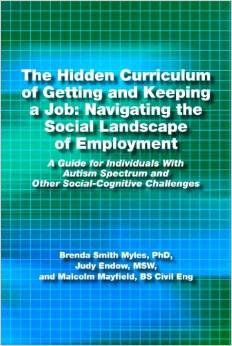
Myles, B. S., Endow, J., & Mayfield, M. (2013).  The Hidden Curriculum of Getting and Keeping a Job: Navigating the Social Landscape of Employment. Shawnee Mission, KS: AAPC Publishing.

Originally written for and published by Ollibean on July 17, 2014

We Are Not In Our Own World

We need to be careful about how we think about and talk about people with disabilities. One example is the reference that those who are autistic or deaf or blind or have some sort of movement differences are “in their own world.”

The fact is we all share the very same world. But we also all try to make sense out of the world we live in. One way we all make sense of what we see in other people is to assign meaning to what we see according to what it would mean if we were engaging in that behavior. Most of the time this strategy serves us well (Endow, 2013).

Here are examples of behavior from students I’ve seen in schools along with the erroneous meaning assigned to the behavior and followed by the actual reason for the behavior.

Head Banging

Behavior: This little girl banged her head onto concrete walks and into walls several times a day both at home and at school. She was so forceful as to give herself a concussion. Because of that she was wearing a helmet.

Meaning Assigned to Behavior: People tried to make sense out of this little girl’s head banging. They took data in attempts to discover a pattern. They used the data to conclude the girl engaged in head banging whenever she was asked to do something she didn’t want to do.

Actual Reason for Behavior: After six months of mostly unsuccessful behavior shaping and reward systems it was discovered the little girl had a severe case of head lice. Once the head lice was eradicated the head banging stopped completely.

Dropping To The Floor

Behavior: Whenever this First Grader left his classroom with the rest of his class when he crossed the threshold into the hallway he would drop to the floor yelling, “No, no, no!”  He would roll around on the floor until an adult approached him. As soon as the adult tried to take his hand and help him up this little boy would start playfully pulling back on her hand and giggling. After a short time of this he would get up and walk down the hallway to his destination. When the child was the only student leaving the classroom with the Speech Therapist or the Reading Specialist he did not fall to the floor.

Meaning Assigned to Behavior: Everyone on this child’s IEP Team had decided that he “pitched a fit” when leaving the room with the rest of the class because he preferred the one on one attention of an adult – any adult. They collected data and used it to confirm their hypothesis was correct because the “fit throwing” only happened when the little boy left the room with his classmates, but whenever he left with any adult, even a stranger, he did not “throw his fit.”

Actual Reason For the Behavior: The little boy had an unreliable sense of proprioception. For him, whenever seeing much movement was combined with space change along with lighting change his sense of proprioception bottomed out. These conditions were met each time several students left the classroom at the same time. When the little boy left the classroom with only one other person the movement was much less so as long as he held the hand of the adult his proprioception was such that he could walk down the hall even though the space and lighting had changed. Additionally, when his proprioception betrayed him and someone took his hand trying to help pull him up it delivered proprioceptive input to his joints and muscles after which he was able to stand up and walk.

These are but two of numerous examples of what can happen when we assign meaning to behavior according to what that behavior would mean if we were engaged in it.  Furthermore, sometimes even the data we collect actually supports our wrong guess!

This is so dangerous.  We wind up assigning negative character traits to our children. In the stories above the little girl was thought to be stubborn and insisting on having her own way and the little boy was labeled an attention seeker. Once the negative character traits have been assigned we all feel off the hook in terms of needing to solve the problem – in fact we start thinking and even saying that it is the child’s own fault, blaming him for willful behavior (Endow, 2013).

Both of these children were nonverbal and both were said to be “in their own worlds” when they were, in fact, engaging in behavior that communicated very real problems. We need to stop saying people are in their own world when they have disabilities or different neurologies such as autism. It serves nobody well when our words draw a line, placing those who are different away from us, those we say are “in their own world” on the other side of that line – the side for those people who we can then not consider real human beings. After all, they are “in their own world.”

Whether we understand somebody else’s behavior or not the fact remains we all share the very same world. To speak differently not only attempts to minimize the humanity of others, but also sets us up for our own failure as human beings. If you describe autistic or disabled people as in their own world will you please stop?

Thank you so much,
Judy Endow

REFERENCE

Endow, J. (2013). Painted Words: Aspects of Autism Translated. Cambridge, WI: CBRPress.

10450855_10152378174373177_3909278251549774901_n

BOOKS  BY JUDY ENDOW

Endow, J. (2019).  Autistically Thriving: Reading Comprehension, Conversational Engagement, and Living a Self-Determined Life Based on Autistic Neurology. Lancaster, PA: Judy Endow.

Endow, J. (2012). Learning the Hidden Curriculum: The Odyssey of One Autistic Adult. Shawnee Mission, KS: AAPC Publishing.

Endow, J. (2006).  Making Lemonade: Hints for Autism’s Helpers. Cambridge, WI: CBR Press.

Endow, J. (2013).  Painted Words: Aspects of Autism Translated. Cambridge, WI: CBR Press.

Endow, J. (2009).  Paper Words: Discovering and Living With My Autism. Shawnee Mission, KS: AAPC Publishing.

Endow, J. (2009).  Outsmarting Explosive Behavior: A Visual System of Support and Intervention for Individuals With Autism Spectrum Disorders. Shawnee Mission, KS: AAPC Publishing.

Endow, J. (2010).  Practical Solutions for Stabilizing Students With Classic Autism to Be Ready to Learn: Getting to Go. Shawnee Mission, KS: AAPC Publishing.

Myles, B. S., Endow, J., & Mayfield, M. (2013).  The Hidden Curriculum of Getting and Keeping a Job: Navigating the Social Landscape of Employment. Shawnee Mission, KS: AAPC Publishing.

Originally written for and published by Ollibean on August 20, 2013

Excerpt from The Hidden Curriculum of Getting and Keeping a Job: Navigating the Social Landscape of Employment

CHAPTER FOUR
THE HIDDEN CURRICULUM BEYOND THE JOB MATCH

The job match is considered crucial for successful employ­ment of anybody, but especially so for adults with social-cognitive challenges, including those with autism spectrum disorders (ASD), who tend to thrive in jobs whose requirements match their personal strengths and preferences (Schutte, 2009).

Grandin and Duffy (2008) identified jobs that are compatible with the learning style of visual thinkers and nonvisual thinkers. They have also identified vocations that are less suitable (see Table 4.1).

Researchers Howlin, Alcock, and Burkin (2005) attempted to quantify the concept of job matching for adults with high-function­ing autism spectrum disorders (HFASD) by identifying the types of work held by 89 adults with HFASD. Table 4.2 highlights the type of work, examples of jobs within each type, and the percentage of adults who held this type of position.

Many of these jobs have structure, routine, and focus on a special interest, all crucial attributes when finding suitable employment for individuals with ASD (Hagner & Cooney, 2005). Researchers and practitioners further assert that adults with HFA are successful in jobs that require few or very structured social interactions. For example, jobs that incorporate mentors (see Chapter Two) who clearly specify job responsibilities, expectations, assumptions, and rules provide the predictability necessary for employees on the spectrum. Table 4.3 lists a series of factors that create employment success (Dew & Alan, 2007; Hagner & Cooney, 2005; Hurlbutt & Chalmers, 2004).

Table 4.3
Factors That Lead to Successful Employment for Adults on the Spectrum

Consistent schedule and job responsibilities

• Ongoing relationship with a mentor, who explains specific job duties,
respon­sibilities, expectations, and rules related to productivity,
breaks, tasks, social interactions, and how to ask for help

• Predictable social demands

System to keep track of work progress

• Predictable routines for lunch, breaks, and other unstructured times
during the workday

• Time before the beginning of the workday to organize self and tasks

• Direct communication with opportunities for clarification and
verification

• Reminders and reassurances

• Coworkers who initiate interactions and help “keep an eye out”
for the em­ployee

• If support providers are involved, a method to transfer these
services and supports to the mentor and fellow employees

Adults with classic autism and with HFASD rank the lowest among all disability groups in employment, with 6% and 12%, respectively, having jobs (http://www.autism.org.uk/living-with-au­tism/employment.aspx). This, combined with the short job tenure of high-functioning adults on the autism spectrum, makes it clear that the concept of job matching must be broadened to take into consideration the hidden curriculum beyond the job match. That is, the traditional notion of job matching is only one component since many adults can easily master the job task itself. Among those who get hired, many find that the work environment, along with all the complex everyday situations generated by the various players, tips the scales in such a way as to become the deal breaker in terms of keeping the job.

In this chapter, we will look at elements of the work-related hidden curriculum that are known to pose challenges for individu­als with autism and other social-cognitive difficulties who otherwise meet the specific “technical” requirements of a given job. These include (a) arriving at work ready to engage, (b) managing stress to maintain engagement throughout the workday, and (c) interpreting and reacting to social demands.

Excerpt from The Hidden Curriculum of Getting and Keeping a Job: Navigating the Social Landscape of Employment, pp. 45-49.

Curric

BOOKS  BY JUDY ENDOW

Endow, J. (2019).  Autistically Thriving: Reading Comprehension, Conversational Engagement, and Living a Self-Determined Life Based on Autistic Neurology. Lancaster, PA: Judy Endow.

Endow, J. (2012). Learning the Hidden Curriculum: The Odyssey of One Autistic Adult. Shawnee Mission, KS: AAPC Publishing.

Endow, J. (2006).  Making Lemonade: Hints for Autism’s Helpers. Cambridge, WI: CBR Press.

Endow, J. (2013).  Painted Words: Aspects of Autism Translated. Cambridge, WI: CBR Press.

Endow, J. (2009).  Paper Words: Discovering and Living With My Autism. Shawnee Mission, KS: AAPC Publishing.

Endow, J. (2009).  Outsmarting Explosive Behavior: A Visual System of Support and Intervention for Individuals With Autism Spectrum Disorders. Shawnee Mission, KS: AAPC Publishing.

Endow, J. (2010).  Practical Solutions for Stabilizing Students With Classic Autism to Be Ready to Learn: Getting to Go. Shawnee Mission, KS: AAPC Publishing.

Myles, B. S., Endow, J., & Mayfield, M. (2013).  The Hidden Curriculum of Getting and Keeping a Job: Navigating the Social Landscape of Employment. Shawnee Mission, KS: AAPC Publishing.

Inclusion – How it Works Best for This Autistic

As an autistic, I sometimes feel boxed in by the best practice strategy of inclusion. Please don’t get me wrong – inclusive education is a very good thing! Historically, people with disabilities were not given access to public education. Then, over time, laws changed. Today we have special ed classrooms in our schools and the progressive schools practice inclusion.

Today’s Inclusive Education
Inclusion means that all the students get to learn in the general ed environment. Instruction is differentiated while physical, sensory, emotional and every other need of each student is taken into consideration so that all students learn together, each one doing and being his very best self. Inclusion allows each student to belong to the community of his peers.

My Personal Take on Inclusion
I love the idea of inclusion. It is right and good. It is very important. AND sometimes this setup doesn’t work well for me. I am not able to access my thoughts and words in real time. Even a quiet environment, with several people in the same room does not necessarily allow me access to those people or even to my own thoughts. Sometimes this sort of situation can propel me into shutdown or meltdown.

In fact, now that I have access to the typical world and experience an inclusive adult life in my community I am discovering that I don’t always want to participate in the typical world. If inclusion is good and right then why is this?

A Breadth of Inclusive Experience
As I ponder this question for myself as an autistic, I realize that the world is run according to the majority. This means a neurotypical (NT) brain is what is behind the conventional constructs of our society. Inclusion looks the way inclusion works for the NT majority. Inclusive opportunities and indeed, all of inclusive education and life, happens via NT style. It is what we have. It works for NTs and it even works for me some of the time. It allows a breadth to inclusive experiences.

A Depth of Inclusive Experience
But at other times I need to honor my autistic neurology. While I love being part of the everyday fabric of life in my community, I also need to spend time living my life with other autistics. This is where I find the depth of inclusion my heart and soul searched for my whole life. It feels like home to me. It is the place where I do not need to inhibit my natural noises, flaps and extraneous movements and moans. I do not need to be mindful of the hundreds of social rules of NT society. I am free to be my true self. My autistic friends do not judge my intelligence, my potential contribution or my human worth by my unconventional mannerisms. I belong, just as I am in my natural state, accepted and loved for my whole self – not just for my NT look-alike self.

The Breadth, the Depth and the Importance of Choice
And still, for me it is quite important to know how to get along in the world at large. I love the freedom of being able to walk in and out of any place in my community and fit in so as to appear to belong. I love being able to take my place in the world at large. I am grateful to have this choice because it hasn’t always been this way in our world.

Additionally, a different and just as valid inclusion comes from the community of my autistic friends where all of me – including autistic traits and mannerisms – are understood and cherished. This is the place where I have the most fluid access to the best of my being, likely because I do not have to inhibit my natural autistic self. To me this is a treasured wonder.

From A History of Marginalization
At the end of the day, I ponder the inclusion situation through history. Being “othered” most of my life in “special” settings never felt like inclusion to me. It felt like being shoved to out of the way places of “less than.” Then later, given only the opportunity for inclusion only NT style I was left wanting and longing for something I did not understand. It wasn’t until I had both that I felt I was no longer an alien, but truly belonged in this world.

To a Future of Comprehensive Inclusion
I believe we may come to discover in the future that to thrive and to be all that we can be, we autistics will need both the breadth of NT inclusion and the depth of autistic inclusion – two distinct and equally important styles of inclusion. As autistics, we also need to be empowered to choose how this mix best works for us in our given autistic bodies. My needs wax and wane over time, but it remains constant that to love and to be loved I need access to both inclusive environments and to be able to choose the mix that serves me best. This allows me to belong and to participate fully in the human race.

10178096_10152303775513177_903087270503951141_n 2

BOOKS  BY JUDY ENDOW

Endow, J. (2019).  Autistically Thriving: Reading Comprehension, Conversational Engagement, and Living a Self-Determined Life Based on Autistic Neurology. Lancaster, PA: Judy Endow.

Endow, J. (2012). Learning the Hidden Curriculum: The Odyssey of One Autistic Adult. Shawnee Mission, KS: AAPC Publishing.

Endow, J. (2006).  Making Lemonade: Hints for Autism’s Helpers. Cambridge, WI: CBR Press.

Endow, J. (2013).  Painted Words: Aspects of Autism Translated. Cambridge, WI: CBR Press.

Endow, J. (2009).  Paper Words: Discovering and Living With My Autism. Shawnee Mission, KS: AAPC Publishing.

Endow, J. (2009).  Outsmarting Explosive Behavior: A Visual System of Support and Intervention for Individuals With Autism Spectrum Disorders. Shawnee Mission, KS: AAPC Publishing.

Endow, J. (2010).  Practical Solutions for Stabilizing Students With Classic Autism to Be Ready to Learn: Getting to Go. Shawnee Mission, KS: AAPC Publishing.

Myles, B. S., Endow, J., & Mayfield, M. (2013).  The Hidden Curriculum of Getting and Keeping a Job: Navigating the Social Landscape of Employment. Shawnee Mission, KS: AAPC Publishing.

Originally written for and published by Ollibean on April 29, 2014

More Than An Autism Diagnosis

I am an adult with autism. My thinking is visual rather than word-based. Autism gifts me with a literal and concrete way of thinking. My thoughts are all in full moving color. You can read about this and about my life in my book called Paper Words, Discovering and Living With My Autism. (Endow, 2009a)

“Always, I have a front row seat to watch the show! Each color, with its infinite variety of hues and brightness, has its own movement patterns and sound combinations. Even though spoken words are the medium most often used by people to communicate with me, I am wired to connect to these words through the sound and movement of colors. This is the way I think. It moves quite fast, but even so, tends to be slower than the speed of conversation. This can cause me to look less intelligent. People say I have processing delays. Painting allows me to show my thoughts without the burden of constant translation.” (Endow, 2013)

So, why am I telling you this?

I recently sent an email to friends telling them of my art expression through acrylic painting and inviting them to take a look at the Art Store page on my website with the paintings that show my autistic style of thinking. (www.judyendow.com)

After viewing the paintings along with the above quoted words that go with the paintings, a friend responded saying that I seemed to have connected with a part of myself that has very few adjectives in common with the stereotypical view of autism.

This got me thinking. Stereotypical views of autism are based on the neuro majority assignment of “truth” as they look at us.

All human beings, regardless of neurology, look out at the world through eyeglasses imposed upon them by their own neurology. Then, they assign meaning to the behavior of others according to the meaning that behavior would have were they engaged in it.

Most times this automatic guess is correct, but sometimes – like when neuro majorities are looking at autistics – the guess can be wrong. Over time, this repeated wrong guessing takes on a life of pseudo truth and becomes a stereotypical view. Thus, today we have a stereotypical view of autism that is quite narrow and limited and very much lacking in empathy, generated by those who live in their own world (that is not our world)…

Oh my goodness! Isn’t that precisely how neuro majorities describe us! Might it mean that we both – neuro majority and autistic – are making assumptions about the other according to our own yardstick measure that we unwittingly assume, without giving thought, is baseline “normal?”

The autism diagnostic criteria are a report on deviation from the typical neurology. As such it shows a picture of what autistics ARE NOT and highlights what we CANNOT DO as compared to the majority “normal.” It says nothing at all about who we ARE or what we CAN DO. Indeed, our abilities and skills most often remain untapped because the neuro majority does not possess them so have no way to understand or support that development in us. For example, if my way of thinking in the movement and sound of color had been supported as a youngster I likely would have been able to produce paintings long before my late 50’s.

Even so, the negative, deficit-based language of diagnostic criteria is not good or bad, right or wrong. In fact, it is necessary if we want to utilize health insurance to pay for treatment and support of autistic individuals. They must “have” something and that something must be something “wrong” in order for the health care reimbursement system to work.

The problem comes when we take the deficit-based language out of the diagnostic realm and start using it to define the humanity of individuals with autism. It imposes limits on the way people think about us and in turn on the opportunities they extend to us.

So my friend was almost exactly right when saying that, through my painting, I seemed to have connected to a part of myself that has very few adjectives in common with the stereotypical view of autism. I say, “almost exactly right” because I have not connected with this part of myself. This IS “myself” – always has been. The real of me – the essence of who I am as a human being – has very few adjectives in common with the stereotypical view of autism!

When talking about autistics – individuals who have been diagnosed with autism – it is important to realize your words have power, often opening or closing doors. What you say and how you say it really does matter. (Endow, 2009b) Please do not use the deficit-based diagnostic criteria of autism to describe my humanity – or the humanity of any autistic.

In this age of the stereotypical view of autistic people, mainly due to the autism awareness campaigns, here are some ideas to help any neuromajority person who may be interested to see beyond an autism diagnosis in an autistic person:

  • When interacting with an autistic think of that person rather than what you happen to know about autism. What you know about autism may or may not apply to a person with whom you are interacting. And even if it does apply, it will not do much for you in terms of getting to know that person.
  • Think of the person you are interacting with rather than the language pigeonholes you have heard applied to autism such as low-functioning and high-functioning. Nobody actually has a precise definition of those words. After all, how would you respond if someone asked you, “Are you high-functioning or low-functioning?”
  • Realize that autistics are measured against the majority “normal” in order to get a diagnosis and, if young enough, early intervention. This measure is one of “less than” as a diagnostic necessity, but please remember we are not “less than” human beings. We have a diagnosis – not a flawed humanity. We have different operating systems. This means we may struggle with many of your ways and have to overcome many obstacles to fit into your world, but we are not less than – just different.
  • Get to know us for what we can do rather than for the diagnostic criteria attached to our label. This may be hard because the majority of social conversation and news media reporting is laden with definitions of autism, which of necessity are deficit-based. This is what people have come to know about autism. It has become our “public image” so to speak. But at the end of the day don’t we all like to be known for our strengths – for what we can do rather than for our struggles? Don’t we all want to be seen in our best light as good human beings in this world?

White Thought Wave on GreenPainting is White Thought Wave on Green by Judy Endow

Note: Greeting cards along with prints in three sizes
available for purchase at the
Art Store on www.judyendow.com

BOOKS  BY JUDY ENDOW

Endow, J. (2019).  Autistically Thriving: Reading Comprehension, Conversational Engagement, and Living a Self-Determined Life Based on Autistic Neurology. Lancaster, PA: Judy Endow.

Endow, J. (2012). Learning the Hidden Curriculum: The Odyssey of One Autistic Adult. Shawnee Mission, KS: AAPC Publishing.

Endow, J. (2006).  Making Lemonade: Hints for Autism’s Helpers. Cambridge, WI: CBR Press.

Endow, J. (2013).  Painted Words: Aspects of Autism Translated. Cambridge, WI: CBR Press.

Endow, J. (2009).  Paper Words: Discovering and Living With My Autism. Shawnee Mission, KS: AAPC Publishing.

Endow, J. (2009).  Outsmarting Explosive Behavior: A Visual System of Support and Intervention for Individuals With Autism Spectrum Disorders. Shawnee Mission, KS: AAPC Publishing.

Endow, J. (2010).  Practical Solutions for Stabilizing Students With Classic Autism to Be Ready to Learn: Getting to Go. Shawnee Mission, KS: AAPC Publishing.

Myles, B. S., Endow, J., & Mayfield, M. (2013).  The Hidden Curriculum of Getting and Keeping a Job: Navigating the Social Landscape of Employment. Shawnee Mission, KS: AAPC Publishing.

Originally written for and published by Ollibean on April 16, 2014